
Introduction
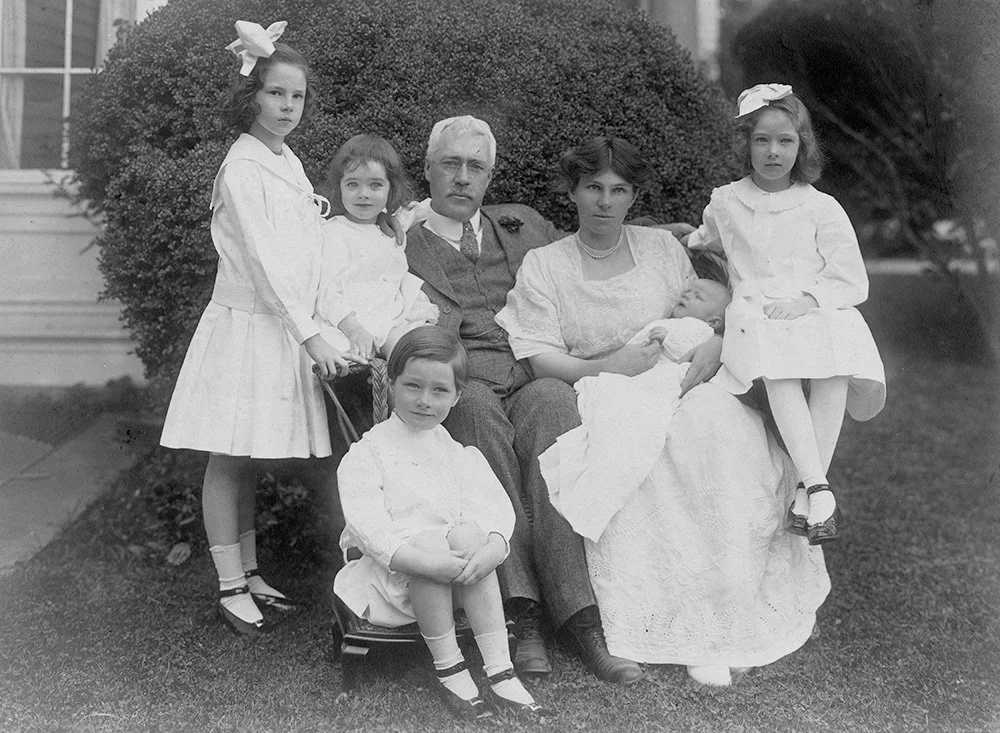
The title above is taken from Frank Vanderlip’s own autobiography: “From Farm Boy to Financier. An Autobiography of one of the architects of the Federal Reserve System”. We’ve now prepared almost fifty of these notebooks and the story of Frank Vanderlip is, to me, one of the most remarkable. The title does not do it justice. He came from humble origins; worked on his family farm; did a couple of stints working as a lathe operator in a factory; became City Editor of a small local newspaper; moved to the Chicago Tribute, eventually becoming financial editor; went to Washington D.C. as private secretary to the Treasury Secretary; shortly afterwards became himself Assistant Secretary of the Treasury; from there became Vice-President and later President of National City Bank of New York (then the largest bank in the U.S. He was one of the architects of the Federal Reserve System.
Early Life
Frank Vanderlip was born on November 17, 1864, in Aurora, Illinois, one of several children of Charles Edmond and Charlotte Louise Woodworth Vanderlip. He spent much of his childhood on his family farm in nearby Oswego. His father passed away in 1878 and the family (Frank, his mother and sister) moved to Aurora, where, at the age of 16, he worked in a factory as a lathe operator. After one year at the University of Illinois and another job at the factory, Vanderlip became city editor of the local newspaper, the Aurora Evening Post in 1885. During this period, he formed a friendship with Joseph French Johnson, which would later become important in his life and his career.
Career
By 1886 Vanderlip was working for Moses Scudder. Scudder was primarily concerned with W.T. Baker and Co., a brokerage firm of which he was a member. Secondarily, he was concerned with “The Investors’ Agency”, an investigating enterprise. While working with Scudder, Vanderlip investigated mortgages that secured bond issues, his first training in finance.
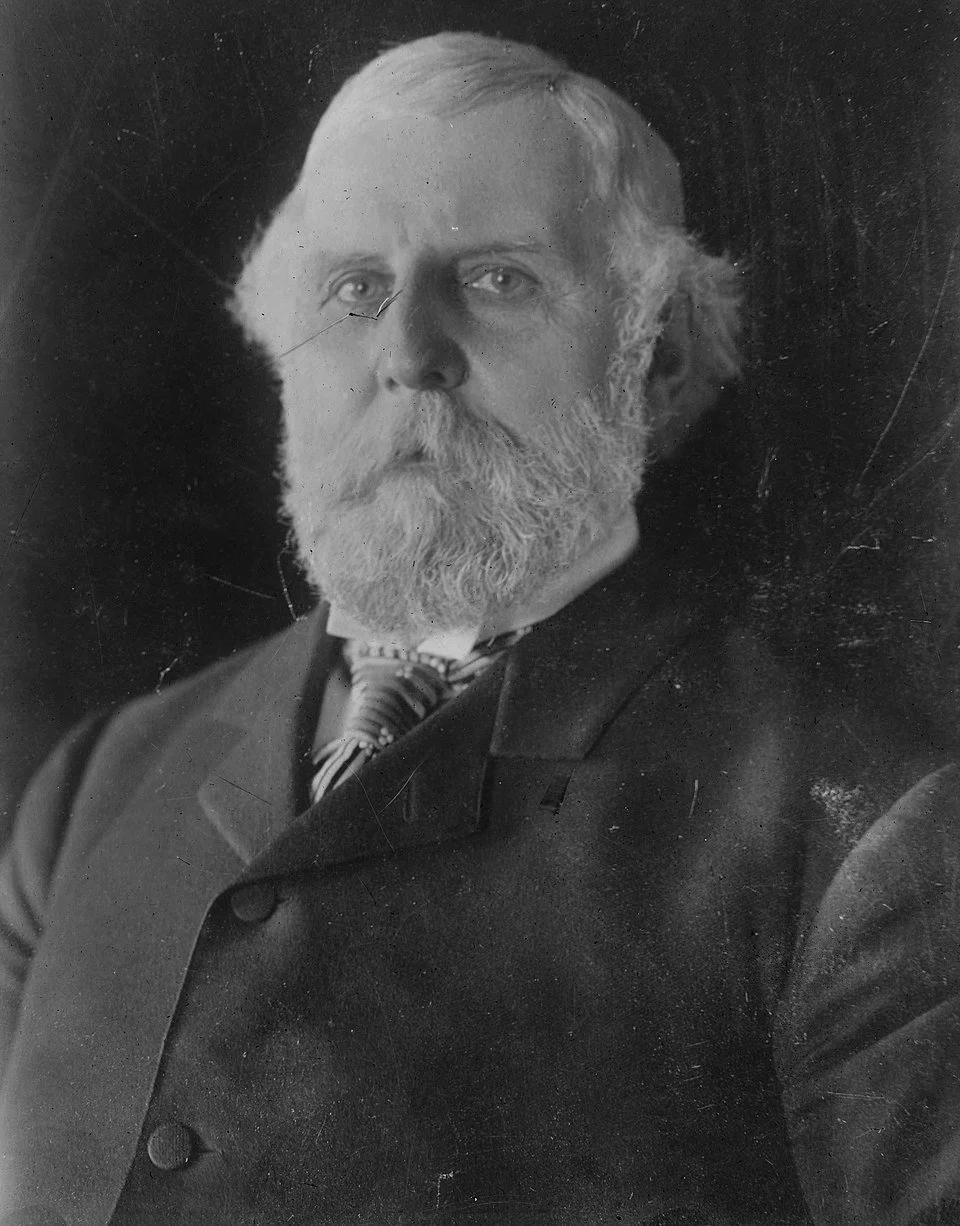
In 1889 he became initially a reporter and later (1892) financial editor of the Chicago Tribune. In 1894 he left the Tribune to become editor of the Economist, a weekly publication established by one of the former financial editors of the Tribune. Through a story he wrote for the Economist he made the acquaintance of Lyman J. Gage the recently appointed US Secretary of the Treasury, which ultimately led to Gage appointing him as his private secretary requiring Gage and Vanderlip to move to Washington, D.C. in 1897. This position was not to satisfy Vanderlip for long. As he points out in his autobiography:
One morning about six weeks later Mr. Gage returned to his office after a visit to the White House.
“I had a talk with the President” he said
I looked up to show my interest.
“I told him I wanted to ask just one favor of him, and I said it would be the only one I would ask during his administration”
“Yes, sir?”
“Well, the President said: “What is it?” and I said: “I want Vanderlip made Assistant Secretary of the Treasury”
I cannot say honestly whether I spoke aloud but I but I know that every fiber of me was asking what Mr. McKinley had said. Even now I can remember Mr. Gage’s eye-glasses held delicately between his thumb and forefinger as he fanned them in a narrow arc. He was watching me with quiet joy as he told me.
“The President said: ‘All right. Send him over’”
Suddenly I remember that an Assistant Secretary rated a carriage and a pair of horses.
Vanderlip was to serve in this position until 1901. While serving he was put in charge of the financial bureaus of the Treasury Department, which gave him “a tremendous dose of precisely the kind of experience I had hoped to have when I had accepted the offer to become private secretary to Mr. Gage.”
The Spanish-American War
The War Revenue Act of 1898, put Vanderlip in charge of overseeing the $200 million bond issue to fund the Spanish–American War. He also took charge of obtaining the subscriptions, starting with the smallest subscribers first, so that the public would feel invested in the fight. Vanderlip led a team of 600 to 700 clerks who succeeded in selling out the bond issue in just over 30 days, closing out the bond drive on July 14, 1898. He was also instrumental in involving his friend, and fellow journalist Edward Walker Harden (who built “The Wilderness” – now “Rosecliff” in Briarcliff Manor) in reporting on the war, in which he achieved astounding success, but that’s a story for another day and another notebook.
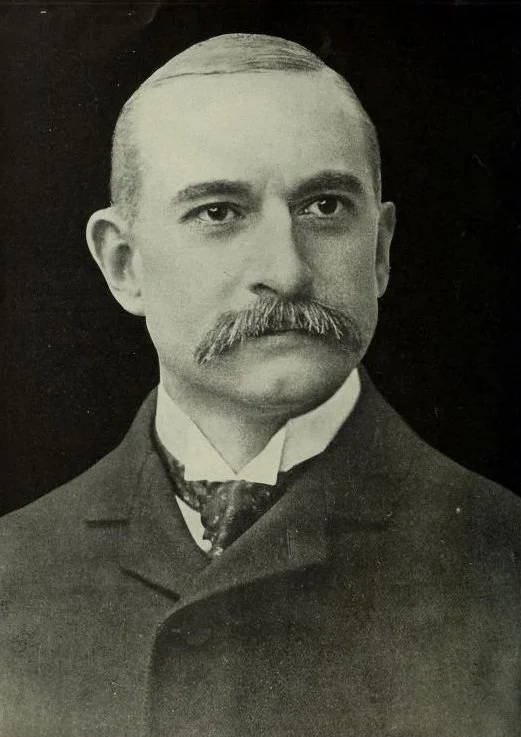
Vanderlip's success brought him to the attention of James J. Stillman, (from whom Walter W. Law bought his first property in Briarcliff Manor), President of the National City Bank of New York, then the country's largest bank. Vanderlip became vice president in 1902 and was president from 1909 until 1919.
The Panic of 1907
The Stock Market and the financial system collapsed during the Panic of 1907. Vanderlip along with other influential bankers (e.g. J. P. Morgan), worked to arrest the run on banks that was heading towards financial disaster. He also joined with prominent Japanese business leaders to formulate an economic relief response to stabilize the US economy by increasing business and financial relations between their nations. His hope was that this would also improve relations between the two countries. In 1908, Vanderlip led a US. delegation to Japan, where they met with Japanese business leaders, including Baron Shibusawa Eiichi. This 1908 visit was the first official, modern day US business delegation to visit Japan
The Panic of 1907 had a profound effect on the thinking of those (including Vanderlip) who were involved. In November 1910 Senator Nelson Aldrich invited a small group (later to become know as the Jekyll Island group) of leading bankers to Jekyll Island, Georgia. They formulated an outline for a plan that eventually led to the drafting of the Federal Reserve Act. In the period immediately before the act's enactment on December 23, 1913, Vanderlip's alternative plan for a Federal Reserve Act nearly derailed the one being advanced by President Wilson and the Democratic leadership. However, a number of Vanderlip's ideas were incorporated into the final Act.
The Federal Reserve Act allowed national banks worth more than $1 million to be involved in the international market. Vanderlip and his vice president at National City Bank, Roger Leslie Farnham, secretly made plans to takeover Bank of the Republic of Haiti through the United States occupation of Haiti. Initial plans would begin in 1909. In 1910 Vanderlip wrote to James Stillman (then Chairman of National City Bank):
"In the future, this stock will give us a foothold [in Haiti] and I think we will perhaps later undertake the reorganization of the Government’s currency system, which, I believe, I see my way clear to do with practically no monetary risk".
Vanderlip testified During the Teapot Dome Scandal hearings in 1924 that he believed that there had been a scandal during the administration of President Warren G. Harding. He spoke out strenuously in support of the public's right to know about issues involved and was forced to resign from the boards of directors of almost 40 companies. He subsequently led a quieter life at his homes in New York and California.
Personal Life & Other Activities
During his life to date Vanderlip had devoted himself to his work. However, in 1903 all that changed. Through his sister, Ruth he was introduced to Narcissa Cox. He describes what happened next in his autobiography:
“All my adult life I had shouldered so much responsibility as to keep my mind closed to romance. However, I suppose I was ripe for it; I was thirty-eight. This Miss Cox, I thought was in inexperienced school-girl, but when she went to Florida, she was followed by the youngest vice-president of the National City Bank. I have never done anything like that before; I have never had any occasion to do it since. I had known her seven days when we became engaged; they were not, however, consecutive days. I still think that I was the most surprised person by the change I had made in my life and certainly I was the most delighted. We were married in the spring (1903) and went abroad on our wedding trip.”
As his family grew Vanderlip felt the need for a “country place”. He described his house hunting experience as follows:
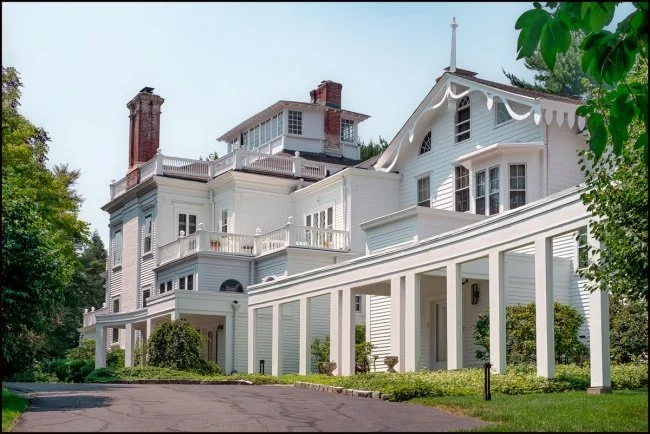
“As a base of operations, a means of orienting ourselves I rented a house in Briarcliff. Then, in Scarborough I found a place I was disposed to buy, but while I negotiated some other buyer stepped in and closed a deal for it (Note: this was most likely the house where Admiral John Lorimer Worden was born, and which would later become the headquarters of Stein and Day publishers). Just across the way from this house that I had lost was a much more pretentious estate, a very old place, that sheltered a relative of the Vanderbilt family. Her children were grown, and she felt Beechwood was too big for her; seventy-five acres and an enormous house. If it was too big for a Vanderbilt, I was quite certain that it was too big for a Vanderlip.”
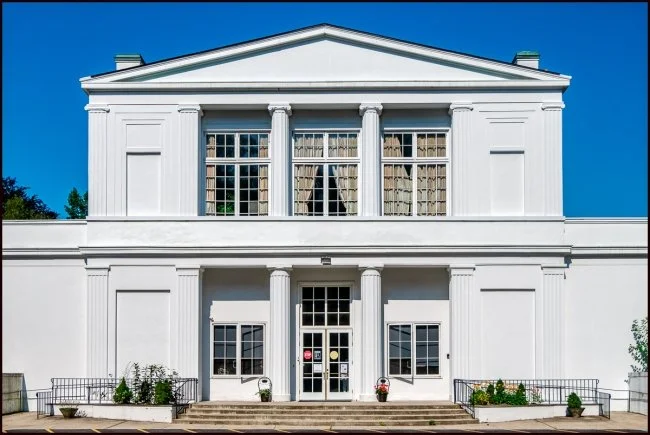
However, James Stillman convinced him to buy it and the Vanderlips purchased: “Beechwood” in 1905. It would eventually grow to one hundred and twenty acres. There they founded the Scarborough School, the first Montessori school in the US. It still exists in Briarcliff Manor as The Clear View School and Day Treatment Center
“Vanderlip [subsequently] purchased several other large parcels, often along with other investors. The Vanderlip-Stillman-Tilghman syndicate bought 15,000 acres of land at the mouth of the Brazos River in Texas, in 1912, and founded the city of Freeport. After several smaller land investments, Vanderlip spearheaded a group that bought 16,000 acres now known collectively as Palos Verdes, California. Vanderlip, known as the "Father of Palos Verdes" purchased the 16,000 acres Rancho de los Palos Verdes from Jotham Bixby in 1913. In 1916, he built the Vanderlip estates near the Portuguese Bend area of Palos Verdes, California where some of his descendants still live. The Vanderlips helped develop landmarks in Rancho Palos Verdes, notably Wayfarers Chapel, Marineland of the Pacific, Portuguese Bend Riding Club, Portuguese Bend Beach Club, Nansen Field, Marymount College and Chadwick School. Vanderlip's original real estate sales office, La Venta, was the first building in the city of Palos Verdes Estates and is now listed as a historical landmark. His original purchase is now divided into four cities: Palos Verdes Estates, Rolling Hills Estates, Rolling Hills, and Rancho Palos Verdes.” (Wikipedia).
His last major purchase was the hamlet of Sparta in Ossining, a quarter mile from his Beechwood home. He bought about 70 homes and business buildings in 1920, believing it to be too run-down. Tearing down dilapidated homes, turning some to face the river, and moving at least one across the street, Vanderlip beautified and gentrified Sparta. Some of these buildings became homes for teachers at Scarborough School. The Vanderlips later gave land in Scarborough to one of their daughters, Narcissa, and her husband Julian Street Jr., for their family home, the Julian Street Jr. residence.
Vanderlip was hospitalized at the New York Hospital in June of 1937, where he died aged 72 two weeks later on June 30. He’s buried in Sleepy Hollow Cemetery.
Sources:
“From Farm Boy to Financier. An Autobiography of one of the architects of the Federal Reserve System”. Frank A. Vanderlip and Boyden Sparkes. New York, D. Appleton-Century Company Inc., 1935
“Frank A. Vanderlip. The Banker Who Changed America”. Vicky A. Mack. Palos Verdes Estates, Pinale Press, 2013 (a more comprehensive take on Vanderlip’s life and work than the autobiography. Possibly also more objective).
“The Changing Landscape. A History of Briarcliff Manor-Scarborough”. Mary Cheever and Briarcliff Manor Scarborough Historical Society. West Kennebunk, Maine, Phoenix Publishing, 1990.
Wikipedia Article: Frank A. Vanderlip - Wikipedia
Wikipedia Article: Scarborough Day School - Wikipedia
History of Palos Verde Estates: History of Palos Verdes Estates - Palos Verdes Real Estate Agent & Realtor - Maureen Megowan
Find A Grave entry: Frank Arthur Vanderlip Sr. (1864-1937) - Find a Grave Memorial
BMSHS Files